

Why Choose a CNC Turning Center?
For precision job shops and OEM manufacturers, the difference between consistent high-quality output and costly scrap often comes down to one machine choice:a professional CNC turning center.
While standard conventional lathes can produce simple cylindrical parts, they fail to meet today’s tight tolerance demands, complex part geometries, and high-volume delivery requirements. A modern CNC turning center integrates turning, drilling, and live-tool milling in one machine, enabling single-setup production for complex rotational components.
Dongs Solution high-performance horizontal CNC turning centers and power turret lathes help manufacturers eliminate repeated fixturing errors, shorten cycle time, and maintain micron-level repeatability across mass production batches.
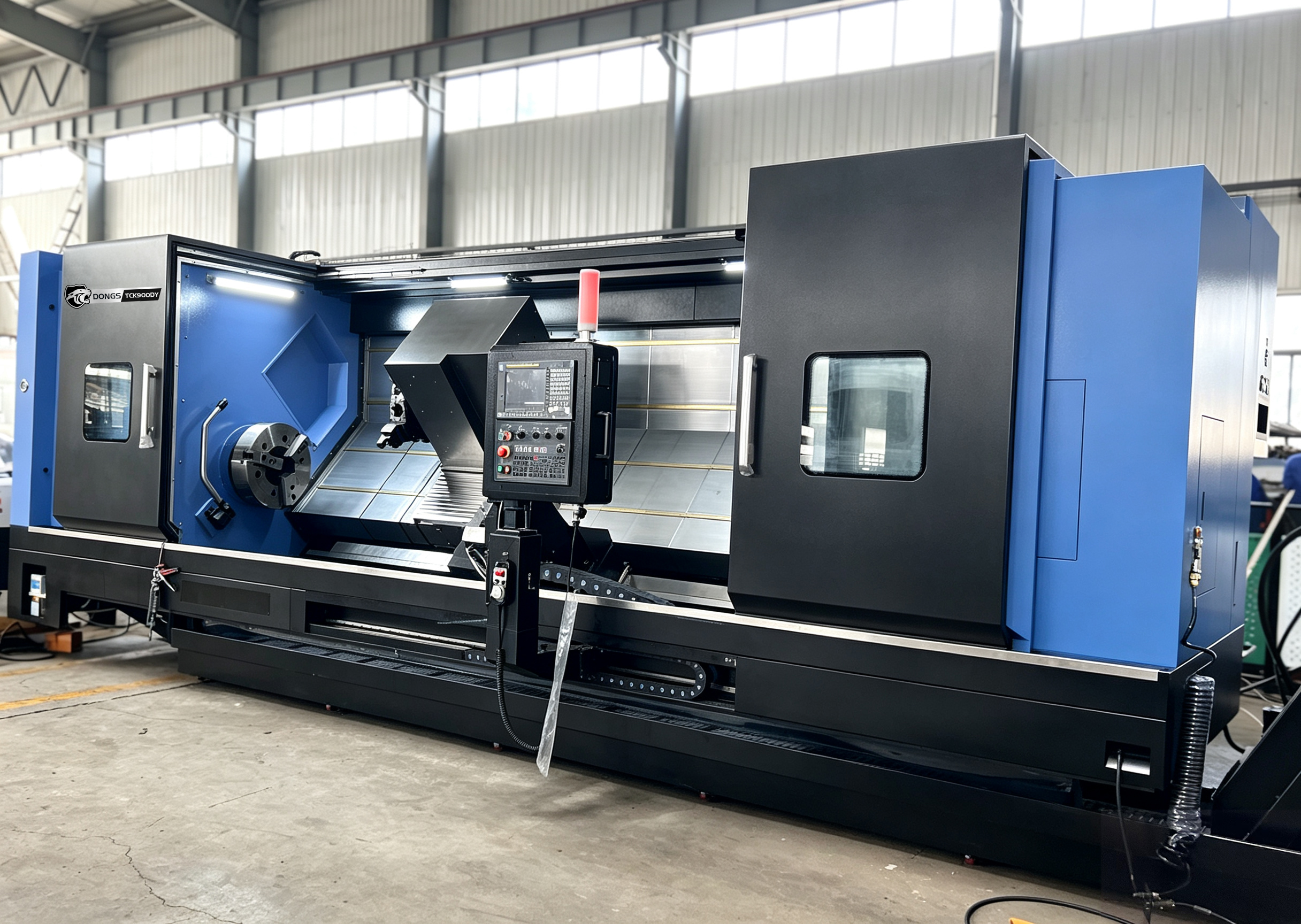
A CNC turning center is a multifunctional computer-controlled lathe designed for high-precision machining of rotational parts. Unlike basic lathes that only perform outer diameter and inner bore turning, a full-featured turning center comes with a power turret, live tooling, and multi-axis capabilities.
This allows manufacturers to complete secondary processes such as cross-hole drilling, keyway milling, and angular slotting without moving the workpiece to a separate machining center.
1. Eliminate Cumulative Fixturing Errors for Higher Precision
Re-clamping workpieces between a lathe and a milling machine is the top cause of dimensional deviation in precision workshops. Every manual setup introduces tiny positioning offsets that accumulate into unqualified parts.
CNC turning centers solve this problem with one-clamp complete machining. Once the workpiece is fixed, all turning, boring, and milling operations are finished in the same coordinate system.
Zero secondary positioning errors
Stable concentricity for long shaft parts
Consistent surface finish on complex profiles
Dongs Solution rigid bed design further suppresses vibration during heavy cutting, ensuring tolerance stability within ±0.001mm for critical components.
2. Boost Production Efficiency & Reduce Lead Time
Traditional production flows require part handling, fixture resetting, tool re-calibration, and offline inspection. These non-cutting times account for over 40% of the total production cycle.
With a multi-functional CNC turning center, manufacturers remove all intermediate workflows. The machine runs uninterrupted from raw bar stock to finished parts.
Cut total cycle time by 30%–50%
Reduce manual labor and workpiece handling
Avoid production delays caused by cross-machine transfer
This advantage is critical for automotive Tier 1 suppliers facing strict quarterly delivery schedules and contractual quality requirements.
3. Superior Structural Rigidity for Hard Material Machining
Hardened steel, stainless steel, and titanium alloys generate strong cutting resistance during processing. Light-duty standard lathes produce chatter and vibration, resulting in poor surface quality and rapid tool wear.
Dongs Solution CNC turning centers adopt finite-element-analyzed cast iron frames and reinforced spindle assemblies. The optimized damping structure neutralizes mechanical resonance during heavy-duty turning and high-speed milling.
Stable performance for hardened alloy machining
Minimize tool wear and replacement frequency
Maintain original accuracy after thousands of running hours
4. Perfect for 3 High-Demand Industrial Applications
Automotive Powertrain Components
Gear shafts, turbocharger shafts, and transmission pins require both cylindrical turning and distributed milled features. CNC turning centers ensure batch consistency for high-volume automotive supply chains.
Surgical handles and titanium implant interfaces demand ultra-high precision and zero error accumulation. Single-setup turning eliminates assembly risks caused by clamping deviation.
Hydraulic & General Industrial Parts
Valve spools, eccentric pins, and precision flange discs rely on integrated turning and cross-hole machining to meet sealing and dynamic balance standards.
5. Lower Operational Cost & Higher Profit Margin
Many manufacturers underestimate the hidden costs of separate machining workflows: high scrap rates, extra labor, tool waste, and delayed shipments all erode profit.
By upgrading to a Dongs Solution CNC turning center, workshops gain long-term cost advantages:
Scrap rate reduced by up to 70%
Less dependency on senior operator experience
Longer machine service life with stable thermal compensation design
Frequently Asked Questions (FAQ)
What is the difference between a lathe and a CNC turning center?
A standard lathe only performs turning operations, while a CNC turning center includes power turret live tooling for milling and drilling, enabling complete part production in one setup.
Is a CNC turning center worth it for small job shops?
Yes. It reduces manual work, lowers scrap rates, and handles complex parts that basic lathes cannot produce, helping small shops win high-value orders.
Can CNC turning centers process titanium and hardened steel?
Yes. Rigid Dongs Solution turning centers are engineered for difficult-to-cut materials including stainless steel, hardened alloys, and medical-grade titanium.
Choosing a CNC turning center is no longer an optional upgrade—it is a necessary investment for manufacturers pursuing higher precision, faster lead times, and stronger market competitiveness. Compared with traditional lathes, it delivers better rigidity, zero clamping errors, lower operational costs, and wider part compatibility.
Contact Dongs Solution today to get a customized CNC turning center solution, professional process analysis, and a free machine quote for your production workshop.