

Can Turning and Milling Be Done on the Same Machine?
Introduction
Many job shop owners and CNC engineers ask the same core question: Can turning and milling be done on the same machine?
The simple answer is yes — with modern multi-axis CNC technology, turning and milling can be fully completed on one single machine in one clamping. Traditional workshops used separate lathes for cylindrical turning and machining centers for milling, which created major bottlenecks for complex parts with both rotational and asymmetric features.
Today, multi-functional turning centers equipped with power turret live tooling integrate turning, drilling and milling into one workflow. As a professional CNC machine manufacturer, Dongs Solution helps manufacturers eliminate repeated fixturing errors and achieve one-setup finished production for high-precision components.
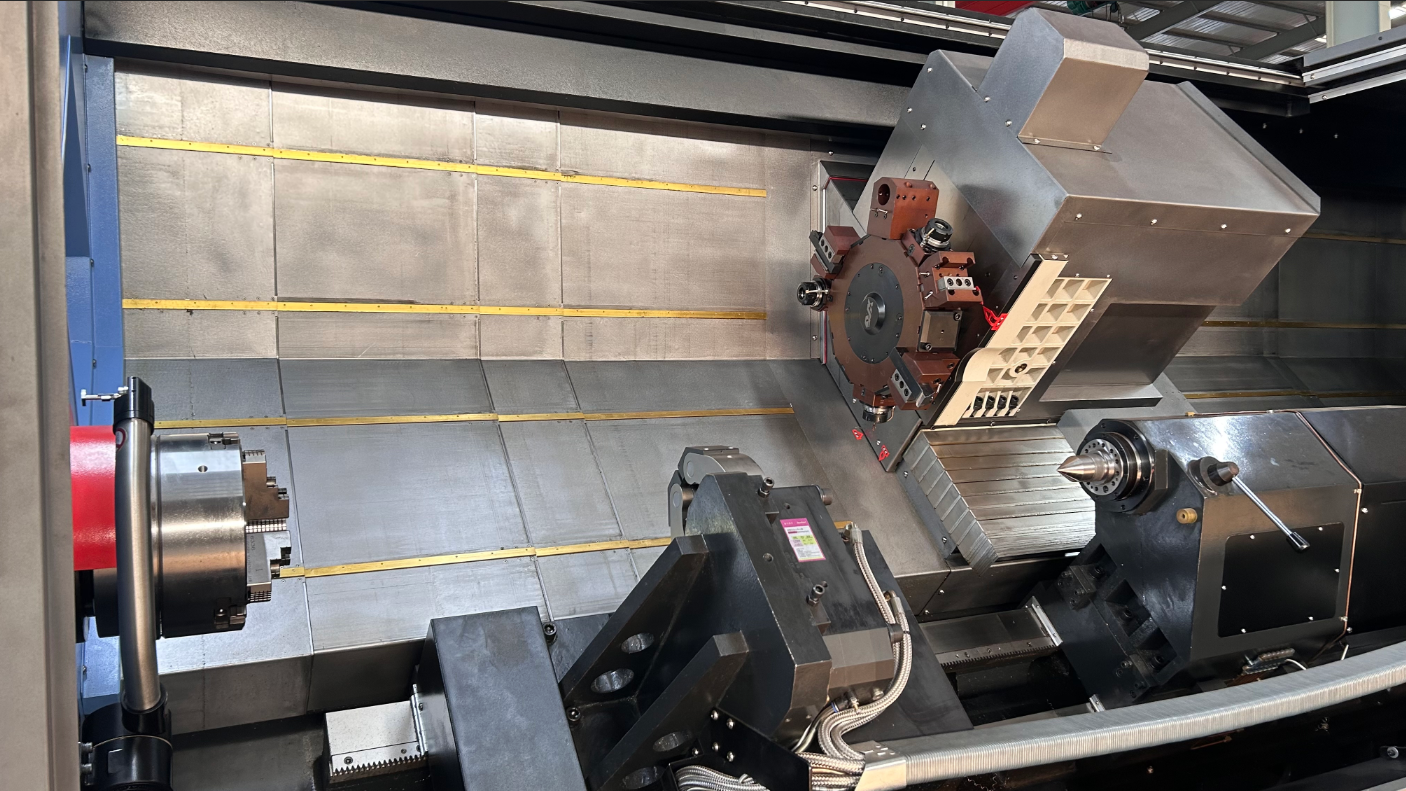
The Evolution of Combined Turning and Milling Machining
For decades, turning and milling were completely separated in conventional manufacturing:
CNC lathes: Only process rotational cylindrical surfaces, bores and grooves
Machining centers: Focus on flat surfaces, keyways, cross holes and irregular contours
This separated workflow forces operators to unload, re-clamp and re-align workpieces between two machines. Every re-fixturing creates tiny positioning deviations, which accumulate into scrap parts — especially critical for automotive and medical components with micron-level tolerance requirements.
To solve this pain point, the industry developed turn-mill composite technology. A modern horizontal turning center combines the rotating spindle of a lathe and driven live tooling of a milling machine, making it possible to finish all operations without removing the part from the chuck.
How Can a Single Machine Perform Both Turning and Milling?
The core technology that enables combined machining lies in two key configurations: a motorized power turret and multi-axis CNC control.
1. Power Turret with Live Tooling
Unlike standard lathe turrets that only hold static turning tools, a power turret delivers rotational power to milling cutters and drill bits. While the spindle rotates for outer diameter turning, the live tooling can simultaneously perform cross-hole drilling, keyway milling and angular slotting.
2. Synchronized Multi-Axis CNC System
Advanced CNC controllers synchronize spindle positioning, turret movement and live tool rotation. The system locks the workpiece in a fixed coordinate system, ensuring all turned and milled features share the same central datum.
This is why Dongs Solution horizontal turning centers can maintain consistent concentricity and positioning accuracy even after complex multi-feature machining.
Core Benefits of Doing Turning and Milling on One Machine
1. Eliminate Cumulative Fixturing Errors
Positioning deviation caused by repeated clamping is the No.1 cause of dimensional failure. Single-setup turn-mill machining fixes the workpiece once, so all features are perfectly aligned to the central axis.
Zero secondary positioning tolerance loss
Stable concentricity for long gear shafts
Consistent surface finish for complex profiles
2. Shorten Cycle Time & Boost Throughput
Part handling, fixture resetting and tool calibration account for over 40% of non-cutting time in traditional workshops. Combining turning and milling on one machine removes all intermediate procedures.
Reduce total production cycle time by 30%–50%
Cut manual labor and workpiece transfer work
Avoid delivery delays caused by cross-machine logistics
3. Higher Rigidity for Hard Material Machining
Milling generates strong cutting vibration, which easily damages precision on lightweight ordinary lathes. Dongs Solution adopts FEA-optimized cast iron machine beds and reinforced spindle assemblies.
The optimized damping structure suppresses mechanical chatter during heavy-duty turning and high-speed milling, making the machine stable for hardened steel, stainless steel and medical-grade titanium components.
4. Lower Operational Cost & Scrap Rate
Fewer machines mean lower maintenance fees, less floor space occupation and fewer operator shifts. The elimination of clamping errors reduces scrap rates by up to 70%, bringing obvious profit growth for mass production workshops.
Main Industrial Applications for Combined Turn-Mill Machining
Automotive Powertrain Components
Gear shafts, turbocharger shafts and transmission pins require cylindrical turning for journals and milled features for splines and lubrication holes. Single-setup machining ensures batch consistency for Tier 1 automotive suppliers.
Medical Precision Components
Surgical instrument handles and titanium implant interfaces need ultra-high precision. Combined turning and milling avoids assembly risks caused by accumulated clamping deviation.
Hydraulic & General Industrial Parts
Valve spools, eccentric pins and precision flanges rely on integrated turning and cross-hole milling to meet strict sealing and dynamic balance standards.
If you want to know more about which parts require dual processing, read our detailed guide: Which Parts Require Both Turning and Milling Operations?
Frequently Asked Questions (FAQ)
1. Can you do turning and milling on the same CNC machine?
Yes. Multi-functional CNC turning centers with power turret live tooling support complete turning, drilling and milling in one single clamping, also known as turn-mill composite machining.
2. What is the difference between a regular lathe and a turn-mill center?
A standard lathe only performs turning tasks, while a turn-mill center is equipped with driven live tools to finish milling and drilling without transferring the workpiece.
3. Is combined turn-mill machining suitable for high-volume production?
Absolutely. It reduces non-cutting time and scrap rate greatly. With stable repeatability, it is the ideal solution for automotive, medical and hydraulic mass production lines.
Conclusion
Turning and milling can absolutely be done on the same machine with modern multi-functional turning center technology. This integrated machining method solves the inherent defects of separated workflows, including tolerance accumulation, long lead time and high operating costs.
For manufacturers pursuing higher precision, larger throughput and stronger market competitiveness, upgrading to a turn-mill composite machine is no longer an option — it is a necessary upgrade.
Get Your Custom Turn-Mill Solution from Dongs Solution
If your workshop produces complex shafts, medical components or hydraulic parts that require both turning and milling, outdated separated equipment will limit your productivity and profit.
Dongs Solution provides FEA-structured multi-functional turning centers, free machining process analysis, and 24-hour global after-sales service. Contact our engineering team today to get a customized machine quotation and upgrade your production line.