

How Does a CNC Turning Center Work?
Introduction
If you are a CNC programmer, workshop manager, or manufacturing engineer, you may ask: How does a CNC turning center work, and what makes it different from a standard lathe?
Unlike basic conventional lathes that only perform simple turning tasks, a modern CNC turning center is a computer-controlled multi-functional machine tool. It integrates turning, drilling, tapping, and milling in one single clamping process, delivering micron-level precision for complex rotational parts.
In this guide, we break down the full working principle, core components, machining workflow, and industrial advantages of CNC turning centers. Dongs Solution professionalhorizontal CNC turning centers and power turret lathes adopt FEA optimized structure to help job shops and OEMs achieve stable one-setup production.
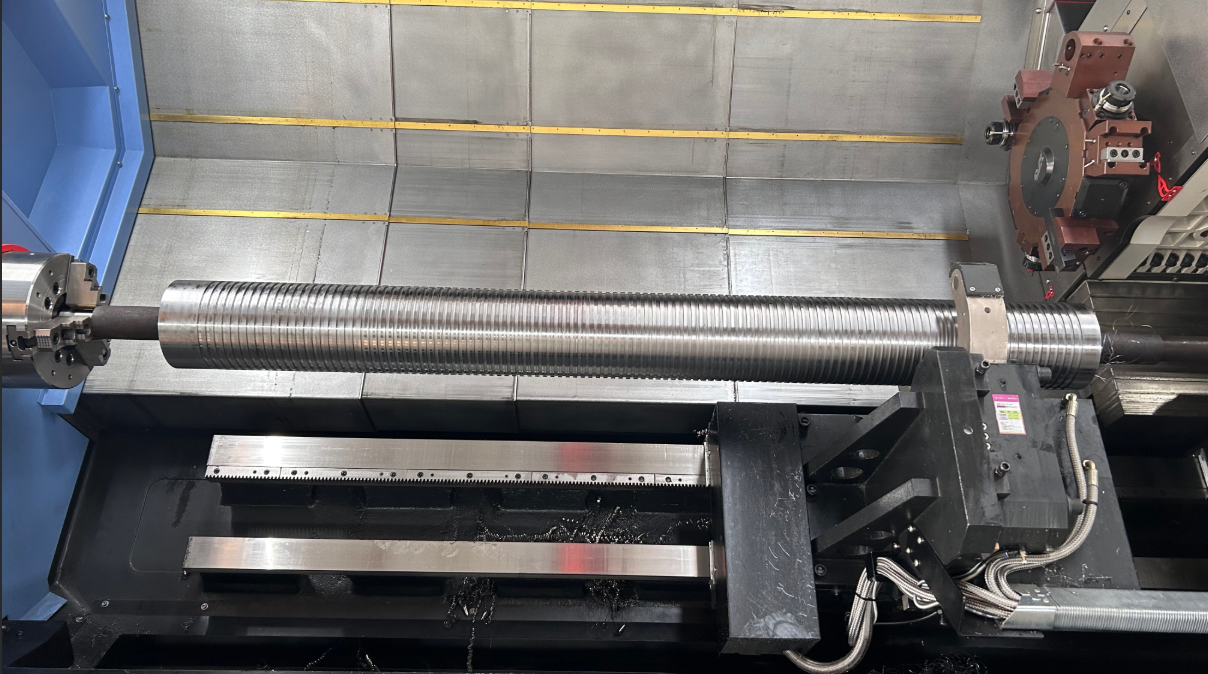
What Is a CNC Turning Center?
A CNC turning center is an advanced computer numerical control machine designed for machining shaft-type, disc-type, and cylindrical components. Compared with ordinary lathes, it is equipped with a servo power turret, live tooling, and multi-axis motion system.
The biggest difference is that a CNC turning center can complete both rotational turning and non-rotational milling/drilling without moving the workpiece to another machine. This is the core reason why it has become the standard equipment for modern precision manufacturing.
Core Components That Make a CNC Turning Center Work
The stable operation and high precision of a turning center depend on five key mechanical and electronic components:
FEA Reinforced Machine Bed Heavy-duty cast iron base reduces vibration and thermal deformation during long-hour cutting, ensuring long-term calibration accuracy.
High-Torque Main Spindle Clamps the workpiece and provides stable rotational power for outer diameter, inner bore, and face turning.
Servo Power Turret with Live Tooling The core functional module: static tools for turning, driven live tools for milling, drilling and tapping.
Multi-Axis Servo Feed System Controls X-axis radial movement and Z-axis longitudinal movement to follow programmed tool paths accurately.
CNC Controller & Operating System Reads G-code programs, synchronizes spindle speed, turret indexing and live tool rotation for fully automatic machining.
Dongs Solution strengthens the overall structural rigidity of these core components, effectively avoiding chatter marks and dimensional drift during heavy-duty cutting.
Step-by-Step Working Process of a CNC Turning Center
Step 1: Workpiece Clamping & Zero Point Setting
The operator fixes bar stock or blank parts on the spindle chuck. The CNC system sets the machining zero point to confirm the workpiece’s coordinate position. Once clamped, the part will not be unloaded until all processes are completed.
Step 2: Program Loading & Simulation
Upload the pre-written G-code program to the CNC controller. The machine simulates the tool path to check for collision risks before formal cutting.
Step 3: Main Turning Process (Spindle Rotating)
The spindle drives the workpiece to rotate at a set speed. Fixed turning tools on the power turret remove material to process outer diameters, inner bores, end faces, and chamfers.
Step 4: Secondary Machining via Live Tooling
This is where a CNC turning center differs from a regular lathe. While the workpiece remains clamped, the power turret activates live tools to complete:
Cross hole drilling and tapping
Keyway and spline milling
Angular slotting and eccentric contour processing
Step 5: Finishing & Automatic Unloading
After finishing all turning and milling features, the machine performs fine finishing to guarantee surface roughness. Finally, the finished part is unloaded manually or via an automatic bar feeder.
Why CNC Turning Centers Outperform Ordinary Lathes
1. Eliminates Re-Fixturing Tolerance Errors
Traditional production requires transferring parts between lathes and milling machines. Every re-clamping creates positioning deviation. A CNC turning center finishes all operations in one setup, keeping concentricity and geometric accuracy within ±0.001mm.
2. Integrate Multiple Processes to Save Lead Time
It eliminates idle time caused by manual handling, fixture adjustment and cross-machine transportation. Factories can cut overall cycle time by 30%–50% and increase daily output significantly.
3. Stable Rigidity for Hard Material Machining
Thanks to the vibration-damping cast iron frame, Dongs Solution turning centers can stably process hardened steel, stainless steel, and medical titanium without tool chatter or surface defects.
4. Lower Labor & Scrap Cost
Fewer machine stations reduce operator workload. The one-setup structure reduces scrap rates by up to 70%, bringing higher profit margins for batch production.
Common Industrial Applications
Automotive Powertrain Parts
Gear shafts, turbocharger shafts, fuel rail components and transmission pins require both cylindrical turning and distributed milled features. CNC turning centers ensure stable batch quality for Tier 1 suppliers.
Medical Precision Components
Surgical handles and titanium implant interfaces demand zero error accumulation. Single-setup turning avoids assembly failure caused by repeated clamping deviation.
Hydraulic & General Machinery Parts
Valve spools, eccentric pins and precision flanges rely on integrated turning and cross-hole milling to meet strict dynamic balance and sealing standards.
For more information about composite processing scenarios, check our article: Can Turning and Milling Be Done on the Same Machine?
Frequently Asked Questions (FAQ)
1. What is the working principle of a CNC turning center?
A CNC turning center rotates the workpiece via the main spindle, uses fixed tools for turning, and activates power turret live tooling for milling and drilling. All processes are completed in one clamping under CNC program control.
2. What is the difference between a CNC lathe and a turning center?
A standard CNC lathe only completes turning tasks, while a CNC turning center is equipped with live tooling and multi-axis functions to perform milling, drilling and tapping, realizing full-part production in one setup.
3. Can a CNC turning center process complex parts?
Yes. It is specially designed for complex shaft and disc parts with cylindrical surfaces, keyways, cross holes and asymmetric features, widely used in automotive and medical industries.
4. Is a CNC turning center suitable for small job shops?
Absolutely. It reduces labor dependence, lowers scrap rates, and enables small workshops to process high-complexity parts to win high-value orders.
Conclusion
A CNC turning center works by combining spindle rotation, servo-axis movement, power turret live tooling and CNC programming to complete turning, drilling and milling in a single clamping. Compared with traditional separate machining, it delivers higher precision, faster efficiency and lower operational costs.
For modern manufacturers aiming to improve batch consistency and market competitiveness, upgrading to a high-performance CNC turning center is the most cost-effective long-term investment.
Get Custom CNC Turning Center Solutions
If your workshop produces precision shafts, medical components or hydraulic parts with strict tolerance requirements, Dongs Solution customized CNC turning centers can optimize your production workflow.
We provide free process analysis, tailored machine configuration, and 24-hour global after-sales support. Contact our engineering team now to get a precise quotation and upgrade your workshop capacity.