

Turning vs Milling: What's the Difference?
Introduction
In CNC precision machining,turning and milling are the two most fundamental manufacturing processes. However, many job shop owners, junior engineers, and procurement managers often mix them up.
If you are wondering: What is the difference between turning and milling, and which one fits my parts? this guide will clarify everything. We break down their core working principles, part suitability, industrial limitations, and how modern machines combine both processes to eliminate traditional production bottlenecks.
As a professional CNC machine manufacturer, Dongs Solution provides power turret lathes and multi-functional turning centers that integrate turning and milling in one platform for modern precision workshops.
Turning vs Milling: Core Mechanical Difference
The biggest distinction between turning and milling lies in which element rotates — the workpiece or the cutting tool. This single rule determines all their application boundaries.
What Is CNC Turning?
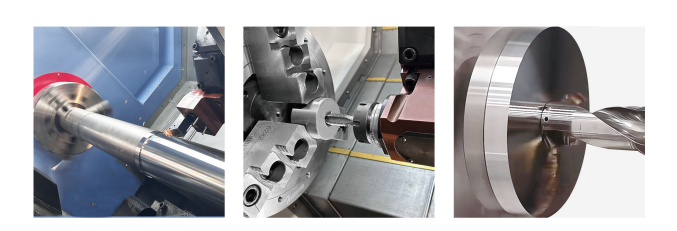
Turning is a material removal process where the workpiece rotates on the spindle, while a stationary single-point cutting tool moves along linear or radial axes to cut material.
Key Characteristics:
Workpiece rotation, fixed cutting tool
Optimized for rotational, cylindrical geometry
Delivers excellent concentricity and surface finish
Best for high-volume shaft and disc production
Typical Parts: Engine shafts, transmission pins, hydraulic spools, bearing discs, cylindrical fasteners.
What Is CNC Milling?
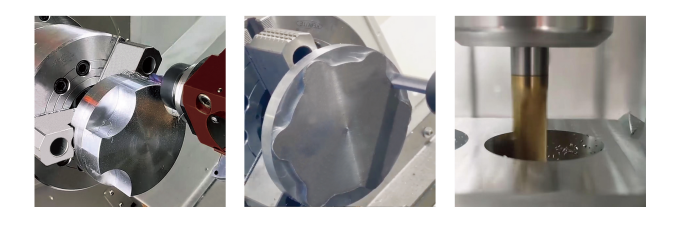
Milling refers to the process where the cutting tool rotates at high speed, while the workpiece remains clamped stationary on the machine table. The multi-flute end mill removes material to form complex shapes.
Key Characteristics:
Rotating cutter, fixed workpiece
Creates non-circular, asymmetric features
Capable of deep slotting, pocketing and 3D contouring
Ideal for flat and irregular mechanical components
Typical Parts: Gear housings, fixture bases, mounting plates, keyways, custom mechanical brackets.
Side-by-Side Comparison Table: Turning vs Milling
|
Comparison Item |
CNC Turning |
CNC Milling |
|
Rotating Element |
Workpiece |
Cutting Tool |
|
Best Geometry |
Cylindrical, rotational parts |
Flat, irregular, 3D parts |
|
Core Advantage |
Perfect concentricity & roundness |
Complex contour & pocket machining |
|
Main Equipment |
CNC lathe, turning center |
Vertical machining center |
|
Tolerance Focus |
Radial runout & diameter accuracy |
Position & profile accuracy |
Industrial Applications: When to Use Turning, Milling, or Both
Most high-value precision parts are not purely rotational or flat — they require both processes. This is why separate lathes and mills create major production pain points.
Automotive Powertrain Components
Transmission shafts, turbocharger shafts and camshafts require turning for cylindrical journals and milling for splines, lubrication holes and keyways. Moving parts between two machines causes cumulative clamping errors, affecting dynamic balance during high-speed operation.
Medical Precision Implants & Tools
Titanium surgical handles and bone implant interfaces feature smooth turned bodies and milled anti-rotation grooves. Even a micron-level positioning error can lead to assembly failure during clinical use.
Hydraulic & Fluid Control Parts
Valve spools and precision flanges rely on turned sealing surfaces and cross-milled flow holes. Consistent indexing between features is critical for leak-proof hydraulic performance.
For more details on composite processing scenarios, read our related article: Can Turning and Milling Be Done on the Same Machine?
The Drawback of Separated Turning and Milling Workflows
Many traditional workshops still separate turning and milling on independent machines. This fragmented workflow creates three unavoidable losses:
Cumulative tolerance errors: Each re-fixturing introduces tiny positioning offset
Long non-cutting time: Manual part handling, alignment and transport waste 40%+ production time
Higher operational cost: More machines, more operators and larger workshop floor occupation
Better Solution: Multi-Functional Turning Centers with Live Tooling
To eliminate the gaps between turning and milling, Dongs Solution integrates both functions into one single machine: the horizontal CNC turning center with power turret live tooling.
How It Solves Traditional Pain Points
Equipped with an FEA-optimized heavy cast iron bed, the machine provides strong vibration damping during aggressive milling cuts. While the spindle rotates the workpiece for turning, the servo power turret activates live tools to finish cross-drilling, tapping and keyway milling in the same clamping.
Zero re-fixturing, zero cumulative tolerance error
Cut total cycle time by 30%–50% for batch production
Reduce scrap rate by up to 70% through unified datum positioning
One machine replaces a lathe + a milling center to save floor space
This structural rigidity and integrated processing capability make turn-mill centers the standard equipment for modern automotive, medical and hydraulic component manufacturing.
Frequently Asked Questions (FAQ)
1. What is the main difference between turning and milling?
Turning rotates the workpiece with fixed tools for cylindrical parts; milling uses a rotating cutter on a fixed workpiece for flat surfaces, slots and complex contours.
2. Can you do both turning and milling on one machine?
Yes. Multi-functional CNC turning centers with power turret live tooling complete turning, drilling and milling in one single clamping setup.
3. Which is more accurate, turning or milling?
Turning delivers better roundness and concentricity for rotational parts, while milling provides higher positional accuracy for asymmetric features. Combined turn-mill machines achieve the best overall precision.
4. Are turn-mill centers worth it for small job shops?
Absolutely. They reduce labor dependence, lower scrap rates, and allow small workshops to process complex hybrid parts to win high-value orders.
Conclusion
Simply put, turning is for rotating cylindrical parts, and milling is for fixed complex profiles. While the two processes serve different purposes, most modern critical components require both. Using separate machines leads to errors, delays and higher costs.
Upgrading to a Dongs Solution multi-functional turning center unifies turning and milling in one stable platform, helping manufacturers achieve higher precision, faster throughput and stronger market competitiveness.
Get Your Custom Turn-Mill Machining Solution
If your parts contain both cylindrical turning features and milled asymmetric features, separate machining will limit your productivity and profit.
Dongs Solution offers rigid horizontal turning centers, free process analysis, customized machine configuration, and 24-hour global after-sales support. Contact our engineering team today to get a tailored quotation and optimize your production workflow.