

What is a Horizontal Turning Center's Role?
Redefining the Core of Modern Manufacturing Floors
The role of a horizontal turning center within a modern manufacturing ecosystem goes far beyond simply shaping pieces of metal; it acts as the central pillar of advanced production efficiency and technological integration. Historically, factory floors were organized sequentially, with raw materials slowly traveling across the shop floor from a simple cutting saw, to a standard turning lathe, then to a dedicated milling station, and finally to a separate inspection area.
This disjointed method of manufacturing was plagued by inherent inefficiencies, massive accumulations of work in progress inventory, and constantly shifting production bottlenecks. The horizontal turning center completely redefines this outdated paradigm by condensing an entire factory floor's worth of machining capability into a single, highly concentrated operational footprint.
Its primary role is to serve as a comprehensive manufacturing solution where raw stock is comprehensively transformed into a fully finished, highly precise component without ever leaving the protective enclosure of the machine. By completely centralizing the physical machining process, it radically streamlines factory logistics, drastically reduces the time parts spend waiting in queues, and profoundly accelerates the entire journey from raw material procurement to final customer delivery.
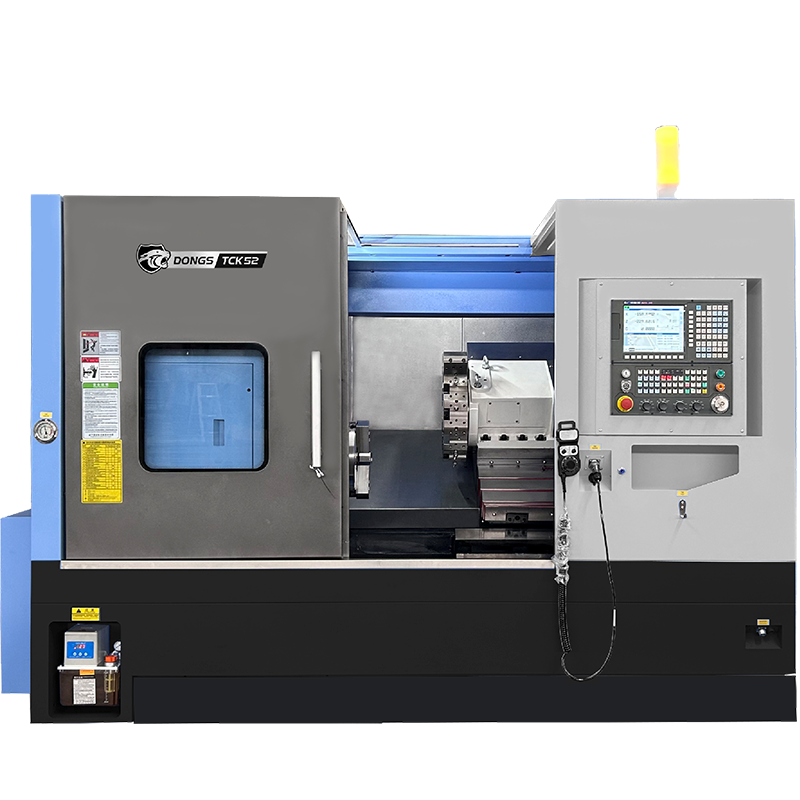
Bridging the Gap Between Turning and Milling
One of the most critical roles this advanced machinery plays is permanently bridging the historical gap between cylindrical turning operations and prismatic milling operations. In traditional engineering, these two core processes were completely segregated, requiring distinctly different machine tools, distinctly different specialized operators, and entirely separate tooling inventories.
A horizontal turning center equipped with a power turret and advanced multi-axis controls brilliantly merges these disciplines. Its role is to aggressively eliminate the boundary between a lathe and a mill. For manufacturing engineers, this means they no longer have to compromise on part design just to make components easier to manufacture on separate legacy machines.
They can design incredibly complex parts featuring off-center holes, intricate face milling, and complex polygonal contours, knowing with absolute certainty that the turning center has the inherent capability to execute every single feature in one highly synchronized operation. This profound level of process integration dramatically boosts machining accuracy because the component never loses its original true center reference point, guaranteeing that every milled slot or drilled hole is perfectly positioned relative to the main turned body of the part.
Enhancing Production Flow and Reducing Bottlenecks
Beyond the technical advantages of multi-tasking, the horizontal turning center plays a pivotal role in optimizing the overall economic flow of a manufacturing business. In a highly competitive industrial landscape, unpredictable machine downtime and labor-intensive part handling are the greatest obstacles to profitability.
By executing all required operations in a single setup, the turning center drastically cuts down non-value-added time wasted on manual clamping, unclamping and repeated part measuring across different machines. Advanced rapid automatic tool change systems enable fast tool switching, keeping the spindle in continuous cutting state and maximizing production output.
This continuous, uninterrupted production capability effectively eliminates long-term shop floor bottlenecks, allowing factory managers to accurately predict production throughput and meet tight delivery schedules for high-demand orders. It evolves from a simple metal cutting machine into a stable, high-efficiency profit-generating core for manufacturing enterprises.
The Foundation for Automated and Lights Out Operations
As global industries move rapidly toward smart manufacturing, the horizontal turning center has become an essential foundational device for fully automated workshops. With complete integrated machining functions, it can be perfectly connected with robotic automation systems.
Modern production lines can match horizontal turning centers with loading and unloading robots to realize automatic feeding and finished part picking. Combined with intelligent bar feeder systems, the machine can finish full-process machining automatically without manual supervision.
This powerful feature enables enterprises to realize lights-out unmanned production, achieving non-stop production day and night. In short, the horizontal turning center is the key technical support for traditional processing factories to upgrade into large-scale, scalable smart factories.
Securing the Future of Smart Manufacturing Investments
Investing in high-grade horizontal turning centers reflects enterprises’ pursuit of high quality, high efficiency and long-term market competitiveness. It provides a flexible, future-proof production platform to quickly respond to fluctuating market demands.
Whether for mass production of standard automotive parts or small-batch customized precision medical components, its strong programmability ensures flexible production switching. To maximize investment benefits, choosing a reliable and professional machine tool supplier is crucial.
Dongs Solution deeply understands actual production demands and supplies high-rigidity, high-stability horizontal turning centers with mature industrial-grade design. All equipment is independently developed and manufactured in-house, adopting heavy-duty castings and top-tier core configurations to ensure long-term stable precision. Supported by 24-hour full-cycle after-sales service, Dongs Solution helps global manufacturers steadily improve production strength and maintain core competitive advantages in the international market.