

What’s the Difference Between Turning and Milling Processes?
Defining the Core Machining Paradigms
In precision manufacturing, turning and milling differ far beyond motion mechanics. They are the two core pillars of subtractive manufacturing, and their working principles are completely different. Mastering their differences helps production managers optimize workflows effectively. In turning, the workpiece rotates against a fixed cutting tool. In milling, the workpiece stays stationary while the cutter moves to remove material. High-precision workshops aim to combine the advantages of both processes and avoid troubles caused by manual part transfers. Modern machining relies on integrated solutions to combine separate procedures into one smooth production flow.
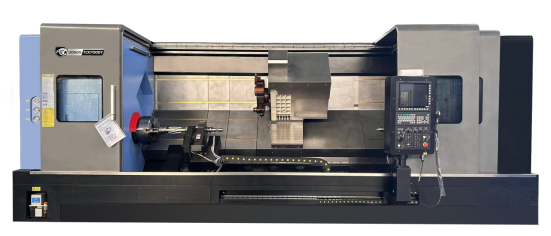
The Operational Mechanics of Turning
Turning is the primary process for manufacturing rotational parts. Manufacturers spin cylindrical workpieces at high speed with cutting inserts to produce accurate diameters, threads and smooth surfaces. It is widely used for automotive shafts, medical bone screws and other rotational components. Traditional lathes only work along a single rotational axis. Parts needing flat surfaces or cross holes must be unloaded for secondary processing, which wastes time and reduces machining accuracy. High-performance horizontal turning centers deliver strong power and torque. They can process tough industrial alloys and greatly reduce dependence on additional equipment.
The Versatility of Milling Processes
Turning works best for symmetrical parts, while milling handles complex geometries. A high-speed rotating cutter moves over fixed workpieces to create intricate contours, pockets, slots and asymmetrical structures. It is indispensable for non-circular precision parts in aerospace and automotive industries. Milling is commonly used for component weight reduction and mounting feature machining — tasks that standard lathes cannot complete. Many workshops run turning and milling as independent processes, with separate teams, tools and setups. This separation causes low efficiency, excess work-in-progress inventory and longer delivery lead times.
Bridging the Gap: The Multi-Function Turning Center Advantage
The multi-function turning center, or live tooling lathe, is a major breakthrough for modern manufacturing efficiency. It breaks the barrier between turning and milling. Equipped with a motorized turret, the machine completes turning and complex milling in one single clamping. Operators no longer need to unload workpieces between processes, which guarantees high positional accuracy for holes, flat surfaces and other features. For auto parts and precision instrument manufacturers, this integrated machining cuts scrap rates and boosts production profitability.
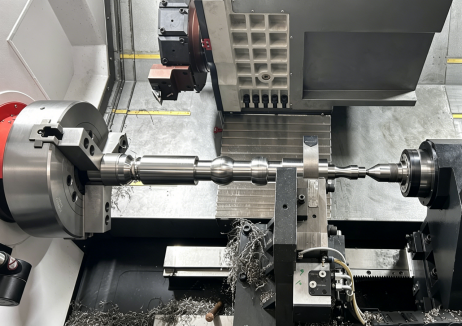
Engineering Integrity and Sustained Manufacturing Quality
Machine stability determines overall performance. Thermal deformation and vibration will ruin micron-level machining precision. At Dongs Solution, we build reliable machines based on solid engineering. Our horizontal turning centers adopt heavy HT300 gray iron beds to effectively absorb vibration. With strict manufacturing standards, the equipment stays stable even under heavy cutting loads. Our clients gain long-term production reliability. Both simple axial pins and complex disk parts can be machined to meet top-tier quality standards.
Strategic Support and Tailored Manufacturing Partnerships
Selecting machine tools is a long-term strategic partnership, not a one-time purchase. Modern manufacturers need reliable partners alongside high-quality equipment. Dongs Solution delivers fully customizable solutions, including special hydraulic turrets and mainstream CNC systems such as Fanuc and Siemens. We provide 24-hour global technical support to keep your production lines running smoothly. Thanks to durable build, professional engineering and timely service, our clients can increase productivity and stand out in the global market.