

What Is a Live Tooling Lathe and How Does It Work?
Defining the Modern Machining Powerhouse
Modern manufacturing depends on high-precision advanced equipment to process complex parts efficiently. The live tooling lathe stands as a core powerful machining device leading industrial processing development, greatly optimizing the traditional part production mode.
Traditional processing needs separate lathes and milling machines. Workpieces require repeated disassembly, clamping and transfer, which wastes plenty of working hours and easily causes positioning deviation and machining accuracy errors.
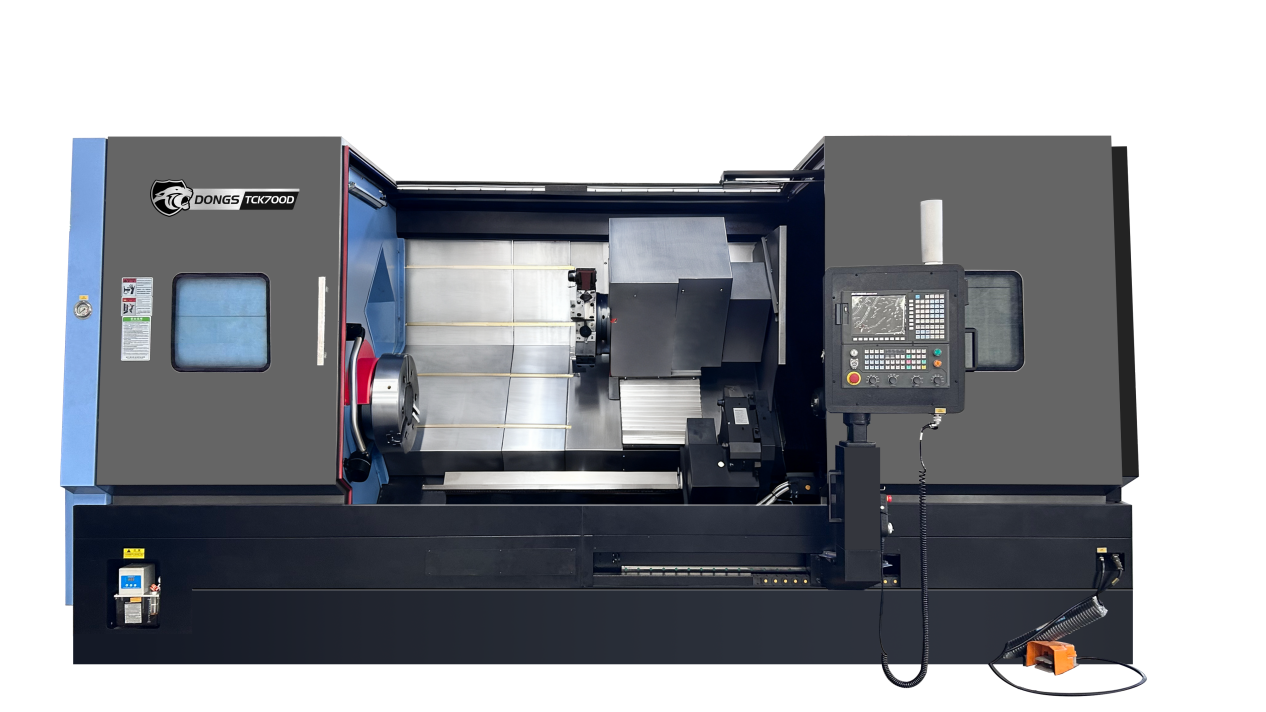
Also known as a multi-function turning center, the live tooling lathe integrates lathe and milling machine functions into one device. It completes turning, milling, drilling and tapping in one single clamping setup. It effectively shortens production cycle, avoids repeated positioning errors, and guarantees excellent concentricity and overall machining precision of finished parts.
The Intricate Mechanics Behind Driven Tools
The core structure of a live tooling lathe lies in its powered turret. Ordinary lathe turrets only fix static cutters, while live tooling turrets are fitted with multiple servo-powered tool stations. Driven by built-in high-torque servo motors, these cutters can rotate independently for cutting work.
When conducting milling, drilling and grooving processes, the main spindle stops continuous rotation and switches to high-precision C-axis positioning mode. The C-axis accurately adjusts and locks the workpiece at a fixed angle.
After stable positioning, live tools rotate at high speed and feed for cutting, completing eccentric holes, special grooves and other complex forming processes. The perfect coordination of C-axis fixed positioning and powered rotary tools enables one-stop compound machining of various complex workpieces without secondary clamping.
Unmatched Efficiency in High Precision Manufacturing
The adoption of this hybrid machining technology delivers unprecedented production efficiency, especially for high-precision manufacturing with strict tolerance requirements. Its core advantage lies in removing redundant secondary processing procedures.
All production procedures are finished in one integrated working system, saving tedious and error-prone repeated workpiece positioning and clamping work. It effectively improves part dimensional accuracy and ensures uniform and stable surface finish quality.
In addition, the rigid machine structure further guarantees long-term high-precision operation. Equipped with heavy-duty slant bed design, these turning centers own outstanding structural rigidity, which can fully absorb strong vibration generated during heavy-duty cutting.
Lower vibration contributes to smoother workpiece surface processing, and greatly prolongs service life of cutting tools. Slower tool wear reduces frequent downtime for tool replacement, realizes longer continuous production, and effectively cuts down overall factory operating costs.
Exploring Real World Industry Applications
This advanced machining technology is widely applied in various high-standard industrial fields worldwide. In the automotive industry requiring mass production with stable quality, live tooling lathes are essential for manufacturing engine parts, transmission shafts and complex brake system components. These workpieces need cylindrical surfaces, precision milled splines and threaded holes, and the all-in-one machining function perfectly meets such diversified processing demands.
In the medical device industry, it is widely used to produce surgical tools, bone screws and orthopedic implants. These critical medical parts need ultra-strict geometric tolerances. The equipment can complete integrated machining on hard materials such as titanium in one pass, complying with strict medical production standards while controlling production costs effectively.
The aerospace industry also heavily adopts this equipment to process professional fasteners, landing gear parts and fuel system valves. For aerospace parts, structural stability and safety are top priorities. The one-time clamping and continuous machining mode avoids precision errors caused by repeated handling and secondary positioning, fully ensuring overall structural integrity of finished components.
Transforming Production Lines with Advanced Engineering
Embracing this level of advanced engineering does more than just improve individual part quality; it transforms the entire economic model of a production facility. Facilities equipped with these modern turning centers can confidently take on highly complex jobs that are unachievable or unprofitable with traditional machinery.
Integrating these units into automated workshops greatly enhances overall production value. Combined with robotic arms and automatic bar feeders, it forms high-efficiency automated production cells that support long-hour unattended operation, widely known as lights-out manufacturing.
When investing in high-performance machining equipment, professional engineering design and reliable build quality are essential. Machines adopting thick cast iron structure for supreme stability and premium core parts for precise motion control guarantee long-term stable and profitable operation.
Dongs Solution insists on solid in-house research and development, supplying stable and durable machine tools suitable for harsh and high-demand working scenarios. Supported by mature production technology and complete 24-hour technical support service, Dongs Solution has become a trustworthy long-term partner for global modern manufacturing enterprises.