

How Does a Live Tooling Lathe Differ from Regular Lathes?
Jun.12.2026
How Does a Live Tool Lathe Differ from Regular Lathes? | Dongs Solution
Core Mechanical Differences Between Two Lathe Types
For machine shop operators, choosing between a standard lathe and a live tool lathe mainly depends on your post-turning processing needs.
A regular lathe is designed exclusively for rotating workpieces to machine inner and outer diameters. It works well for basic turning, facing and threading, yet its functions are limited to rotational operations only.
In contrast, a live tooling lathe, also known as a multi-function turning center, delivers far stronger performance. Equipped with a motorized turret, it can complete milling, drilling and tapping without removing the workpiece. A standard lathe focuses purely on rotary machining, while a live tool lathe acts as an all-in-one production unit, combining the advantages of a conventional lathe and a professional machining center.
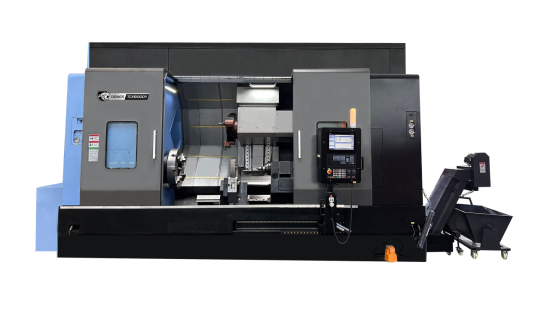
Hidden Drawbacks of Traditional Lathe Workflow
Relying solely on regular lathes will create fragmented production processes.
Take automotive transmission shafts as an example. After turning on a standard lathe, parts still need cross holes, keyways and offset slots. Workers have to unload the workpiece, transport it to a milling machine and re-clamp it repeatedly.
This workflow wastes plenty of working hours. More importantly, repeated clamping greatly increases alignment errors and tolerance deviations, leading to higher scrap rates. Extra labor and inventory costs will continuously cut down corporate profits. For modern manufacturers, upgrading to integrated turning centers has become an essential choice.
Process Complex Shapes with Live Tool Turret
The key advantage of a live tool lathe lies in its high-precision powered turret.
Standard turrets only hold fixed static tools. A live tool turret is fitted with independent servo-driven spindles. When machining side holes, flat surfaces, grooves or polygonal shapes, the built-in C-axis positioning system locks the workpiece firmly in place. The live tools then run at high speed to finish all required processes.
One single live tool turning center can replace multiple traditional machines. It is an ideal solution for the modern machinery industry with increasingly complex part design requirements, ensuring stable and repeatable machining precision.
Higher Efficiency for High-Precision Industries
Multi-function turning centers are widely adopted in industries with strict quality standards, such as medical equipment and automotive manufacturing.
Medical industry: For titanium bone screws and surgical tools, products require mirror surface finish and micron-level tolerances. A live tool lathe avoids repeated part handling and related mechanical deformation.
Automotive industry: It supports fully automated one-stop production from raw materials to finished parts. The streamlined workflow eliminates production bottlenecks, suitable for mass production of standard pins and complex hydraulic manifolds.
Reliable Structure for Long-Term Stable Operation
Advanced functions require solid mechanical structure.
All live tool lathes from Dongs Solution adopt high-density gray iron for machine beds. This material effectively absorbs vibration and guarantees outstanding structural rigidity. We complete full R&D, casting, assembly and testing in-house, strictly controlling every production link.
Our machines are built for 24/7 heavy-duty operation. Excellent durability greatly reduces unexpected downtime, outperforming low-cost ordinary machine tools in long-term running stability.
Custom Solutions & Full-Range Technical Support
Purchasing high-performance CNC machine tools is a long-term cooperation, not a one-time deal.
We provide personalized configuration services to match your actual production demands. Our equipment is compatible with mainstream CNC systems including Fanuc and Siemens. We can also customize hydraulic systems to meet special clamping requirements.
Round-the-clock technical support is available worldwide to solve your problems during peak production. With reliable hardware and responsive after-sales service, we help you boost productivity and stay competitive in the global market.
The future of precision machining lies in integration, flexibility and long-lasting reliability.